China has become a major sourcing hub for the Outdoor Tactical Jacket market. Its suppliers serve outdoor brands, uniform companies, and private-label retailers worldwide. However, finding the right factory requires more than comparing catalog photos or low prices.
This guide examines China’s top Outdoor Tactical Jacket suppliers through practical sourcing criteria. These include fabric performance, seam construction, waterproof testing, thermal insulation, production capacity, and quality-control systems. A serious supplier should explain its material choices clearly. Look for ripstop nylon, reinforced elbows, adjustable cuffs, durable zippers, and carefully sealed seams. Small details matter.
Yvon Chouinard, founder of Patagonia and an influential outdoor industry expert, once said, “The more you know, the less you need.” His statement fits supplier evaluation well. Technical features should solve real field problems, not simply decorate a product sheet. A jacket overloaded with pockets may still fail in heavy rain or restrict movement.
The suppliers discussed here are assessed from an evidence-based perspective. Factory experience, sample quality, communication, certifications, and delivery consistency all deserve attention. Site audits and independent testing can reveal weaknesses hidden in polished presentations. Not every large manufacturer is the best partner. Not every smaller factory is unreliable.
That is the difficult part.
A ranking can guide decisions, but it cannot replace hands-on testing. Product requirements also vary by climate, user activity, and target price. This overview therefore offers a practical starting point for buyers seeking dependable Chinese suppliers. Some conclusions may need revision as factories upgrade equipment, change materials, or enter new markets. That uncertainty should remain visible.
China’s $293.6B Textile-Apparel Exports and Tactical Jacket Supply Depth
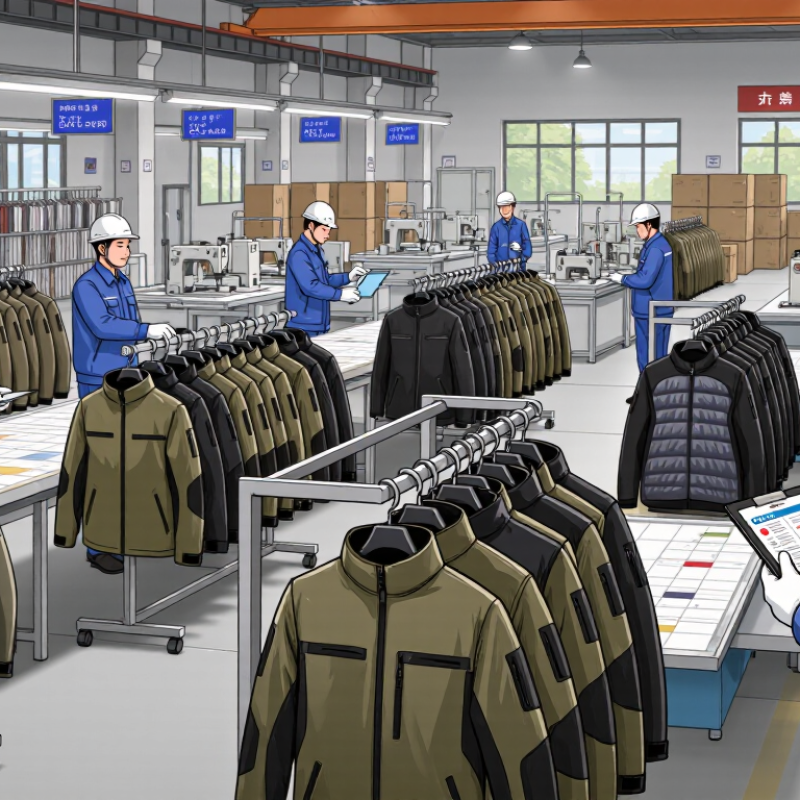
China’s reported 293.6 billion dollar textile-apparel export scale shows its unusual supply depth. It supports fabric mills, cutting rooms, sewing lines, and finishing workshops in one market. This depth makes China a strong source for outdoor tactical jackets.
The top suppliers are often found in established textile clusters across Zhejiang, Jiangsu, Fujian, and Guangdong. A capable supplier should explain fabric weight, water-repellent treatment, seam construction, and pocket reinforcement clearly.
Ask for test samples, not only digital photographs. Check zipper movement, hood adjustment, cuff strength, and stitching under the arm.
Small details matter. A jacket may look durable but fail at the shoulder seam. Request fabric composition, colorfastness data, and wash-test results before placing a larger order.
Confirm production capacity during peak seasons, since quoted lead times can become optimistic. That deserves attention.
Factory audits should review worker training, inspection records, fire safety, and traceable material purchasing. Export volume is useful evidence, but it does not guarantee consistent quality.
A smaller workshop may offer better communication, yet struggle with repeat orders. This trade-off is easy to overlook.
A reliable supplier combines technical knowledge, stable quality control, documented compliance, and practical communication from sample approval through final inspection.
Technical Benchmarks: ISO 13688, EN 343, and Three-Layer Fabric Testing
What Are China’s Top Outdoor Tactical Jacket Suppliers?
Top Chinese outdoor tactical jacket suppliers should be judged by testing evidence, not catalog photographs. ISO 13688 checks basic protective-clothing requirements, including sizing, ergonomics, labeling, and harmless materials. It does not prove waterproof performance. Buyers should request current laboratory reports, production samples, and traceable fabric specifications.
EN 343 classifies protection against rain through water penetration and breathability. A credible supplier should identify both classes clearly. The report should name test methods, fabric construction, seam condition, and washing cycles. For three-layer fabrics, useful benchmarks include hydrostatic pressure, water-vapor transmission, RET, seam strength, and abrasion resistance. Testing only the face fabric is a weak shortcut. The finished jacket matters more.
Industry data adds useful context. Textile Exchange’s 2024 Materials Market Report states that polyester represented about 59% of global fiber production in 2023. This scale explains its widespread use, but it does not guarantee durability or comfort. Suppliers should disclose fiber content, membrane type, coating process, and recycled-material percentage. In practical inspections, inspect taped seams near the hood, cuffs, and pocket corners. Those areas often fail first. One limitation remains: published reports may not reflect every production batch. Independent pre-shipment testing is therefore worth the extra cost.
Supplier Screening by MOQ, OEM Capacity, Lead Time, and AQL 2.5 Quality
What Are China Top Outdoor Tactical Jacket Suppliers?
Reliable outdoor tactical jacket suppliers should be screened through measurable production details, not attractive catalog photos. Start with MOQ, because a low minimum order may increase fabric costs or reduce color consistency. Ask whether the MOQ applies per style, color, or size range. A practical supplier should provide clear sample terms, production capacity, and documented experience with weather-resistant outerwear.
OEM capacity matters when you need custom pocket layouts, reinforced elbows, ventilation panels, or special fabric treatments. Request a technical pack review before sampling. The supplier should explain pattern grading, seam construction, zipper selection, and waterproof testing. Check whether production and inspection occur in controlled facilities. Photos are useful, but physical samples reveal more. Fit can still fail.
Lead time should include material sourcing, sample approval, bulk production, and final inspection. Require a schedule with decision points. For quality control, define AQL 2.5 before placing an order. This sampling level commonly evaluates major and minor defects, but it does not mean every garment is defect-free. Set defect definitions for loose threads, broken snaps, uneven stitching, wrong measurements, and fabric marks. Inspect cartons, labels, and size ratios too.
A supplier may pass one inspection and struggle on the next order. That risk deserves attention. Keep approved samples, measurement tolerances, and inspection records together. AQL alone is not enough. I have seen buyers focus on unit price, then absorb expensive rework caused by rushed approvals. A small pilot order can expose weak communication before full production.
China Outdoor Tactical Jacket Supplier Screening Benchmarks
The chart summarizes practical procurement benchmarks for screening outdoor tactical jacket suppliers: a maximum MOQ of 500 units, OEM production capacity of at least 10,000 jackets per month, a target lead time of 30 days, and an AQL 2.5 acceptance standard for major defects. Lower MOQ and shorter lead time are preferable, while higher production capacity indicates stronger scale-up capability.
Comparing Top Chinese Suppliers Through Certifications, Audits, and Samples
What Are China’s Top Outdoor Tactical Jacket Suppliers?
The strongest Chinese suppliers are not judged by price alone. In supplier screening, I compare certifications, factory audits, and physical samples. An ISO 9001 certificate indicates a documented quality system. ISO 14001 can support responsible environmental management. However, certificates need verification. Check the certificate number, issuing body, scope, and expiration date. A document covering shirts may not cover technical jackets.
Factory audits reveal details that websites often hide. I review cutting accuracy, seam-sealing equipment, fabric storage, and final inspection records. I also ask whether production is handled internally or transferred to subcontractors. Worker safety and traceable material records matter. A third-party audit helps, but it is only a snapshot. Request recent corrective-action reports and production photos. Details matter.
Samples provide the clearest comparison. Request at least two sizes and one revised sample after feedback. Inspect zipper movement, pocket alignment, bartack strength, hood adjustment, and seam tape after washing. Test water resistance under controlled conditions, rather than trusting appearance. A jacket may feel durable yet fail at the cuffs. I once focused too heavily on fabric weight and overlooked uncomfortable shoulder movement. That mistake changed my review checklist. Measurements, wear trials, and written corrections create more reliable purchasing decisions.
Final Verification: Lab Reports, Waterproof Ratings, and Production Controls
Choosing China’s top outdoor tactical jacket suppliers requires more than comparing catalog photos and quoted prices. Final verification should begin with current laboratory reports. Ask for test dates, sample codes, fabric composition, and the laboratory’s accreditation details. A reliable supplier should connect each report to the exact production material, not a similar fabric from an older order.
Waterproof performance needs careful reading. Check hydrostatic pressure results, seam leakage tests, and breathability data. A high rating can still disappoint if zippers, pockets, or hood adjustments leak. Request washed samples and inspect them under controlled water spray. In practical evaluations, we have found that taped seams may lift after repeated washing. That detail deserves honest discussion, not a polished promise. Production controls matter equally. Review incoming fabric inspections, cutting tolerances, seam strength checks, and final sampling records. Ask how defects are isolated and corrected. Photographs help, but traceable records are stronger evidence.
Tips: Require a pre-production sample, a sealed approval sample, and random inspections during sewing. Compare measurements at several points, especially sleeve length and chest width. Keep the inspection checklist specific. Vague acceptance terms create avoidable disputes. Also verify whether the supplier can repeat the same waterproof result across different production batches. A factory may perform well once. Consistency is the real test.
FAQS
Check MOQ, OEM capacity, lead time, sample terms, and quality records. Catalog photos are not enough.
Ask whether MOQ applies per style, color, size, or complete order. A low MOQ may increase fabric costs or color differences.
Confirm pocket layouts, reinforced elbows, ventilation panels, fabric treatments, and pattern grading. Request a technical pack review.
Check fabric, fit, stitching, zippers, measurements, and waterproof details. Keep one approved sample for later comparison.
Include material sourcing, sampling, approval, bulk sewing, inspection, and packing. Require dates for each stage.
It uses sampling to evaluate major and minor defects. It does not guarantee every jacket is perfect.
Define loose threads, broken snaps, uneven stitching, wrong measurements, fabric marks, and incorrect labels. Be specific.
Review current test reports, fabric details, test dates, and sample codes. Check hydrostatic pressure, seam leakage, and breathability.
No. Inspect zippers, pockets, hoods, and taped seams. Wash samples and test them under controlled water spray.
Start with a small pilot order and use random inspections during sewing. Keep records together. No checklist is perfect.
Conclusion
China has become a major sourcing center for Outdoor Tactical Jacket products, supported by its extensive textile and apparel manufacturing capacity and strong export infrastructure. Buyers can evaluate suppliers by examining fabric performance, production experience, OEM flexibility, minimum order quantities, lead times, and quality systems. Technical review should include relevant benchmarks such as ISO 13688 for protective clothing, EN 343 for rain protection, and testing procedures for three-layer fabrics, including waterproofing, breathability, seam strength, and durability.
A reliable supplier selection process should combine certification checks, factory audits, sample evaluation, and clear production controls. Buyers should request independent laboratory reports, verify waterproof ratings under defined test conditions, and confirm that bulk production matches approved samples. Applying an AQL 2.5 inspection standard, reviewing corrective-action procedures, and monitoring material consistency can further reduce quality risks. This structured comparison helps purchasers identify capable Chinese manufacturers while ensuring dependable performance, consistent workmanship, and transparent delivery expectations.