Choosing Outdoor Walking Jackets Womens is not simply a matter of color, price, or seasonal style. A jacket should protect against rain, wind, and sudden temperature changes during real walks. Think of damp park benches, muddy paths, cold fingers, and a phone that must remain reachable. These details often reveal more than a product photograph.
The U.S. Bureau of Economic Analysis reported that outdoor recreation generated about $1.2 trillion in economic output in 2023. It also supported millions of jobs across manufacturing, retail, travel, and services. This scale shows why technical clothing deserves careful evaluation. The Outdoor Industry Association has also reported strong participation in outdoor recreation, including walking and hiking. Demand is growing. Quality expectations should grow with it.
Yvon Chouinard, Patagonia’s founder and a respected outdoor-industry voice, said, “The most responsible thing we can do is buy less.” His point matters here. A durable jacket with repairable details may be more useful than several cheap alternatives. Look for a breathable membrane, sealed seams, adjustable cuffs, a practical hood, and pockets that stay accessible while walking. Fit still requires personal judgment. A jacket that works beautifully in Seattle may feel excessive in a dry, mild climate. No single model suits every woman, every body shape, or every trail. That is easy to forget. This guide compares weather protection, comfort, materials, sustainability, sizing, and everyday value, while recognizing that product claims deserve careful verification.
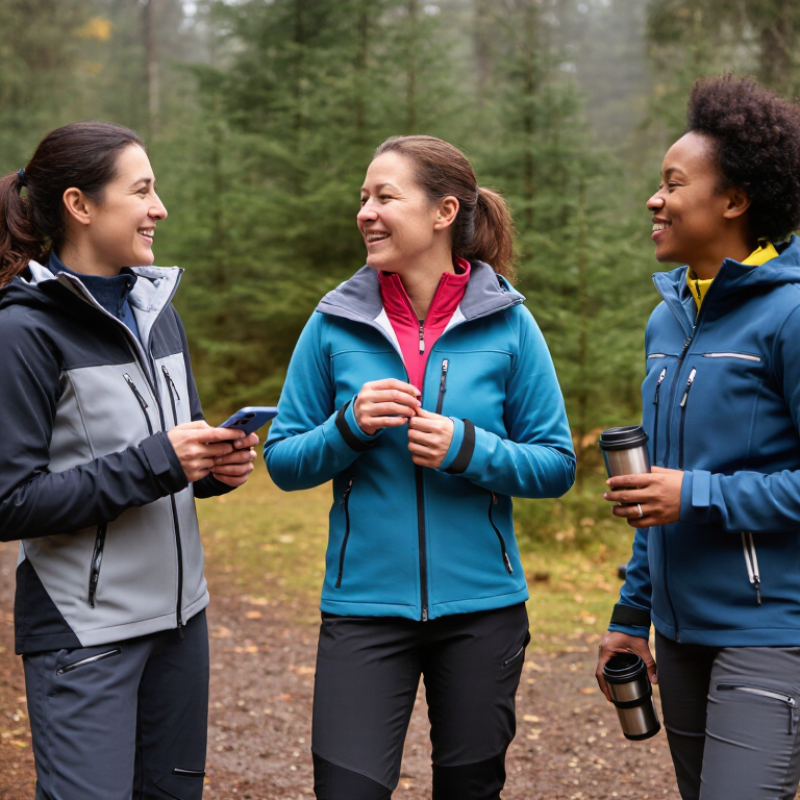
How to Choose Womens Outdoor Walking Jackets?
Start with the walk, not the jacket. A ten-minute commute needs different protection from a three-hour coastal hike. Record your usual distance, pace, elevation, and whether you carry a backpack. NOAA’s 1991–2020 Climate Normals provide monthly temperature and precipitation averages for thousands of weather stations. Check your local station, rather than trusting a citywide forecast. A mild 12°C morning can still feel cold beside an exposed river.
Rain, wind, and humidity change the decision. The National Weather Service explains that wind increases heat loss from exposed skin, while moisture reduces insulation. For wet, windy routes, choose a jacket with a sealed hood, adjustable cuffs, and a breathable construction. For dry autumn walks, a lighter wind-resistant layer may work better. Too much waterproofing can feel clammy during a fast uphill section.
Fit matters during movement. Test the jacket over a thin sweater, then reach forward as if holding trekking poles. Sleeves should cover the wrists without restricting the shoulders. Women’s cuts often shape the waist and chest, but sizing varies widely. Do not assume the smallest size is the best fit. My own practical mistake would be choosing a compact jacket for its weight, then discovering that the pockets cannot hold gloves and a phone. The European standard EN 343 can help compare protection against rain and breathability, but laboratory ratings cannot predict every real trail. Check the forecast shortly before leaving. Conditions change.
Choosing a women’s outdoor walking jacket starts with fit, not color or pocket count. Measure over the layers you actually wear, such as a thermal top and fleece. A jacket that fits over a thin shirt may feel tight on a cold, windy path. Check the shoulder seam. It should sit near your shoulder edge, not halfway down your arm. Raise both arms, reach forward, and mimic holding walking poles. The hem should stay near your hips without riding upward. Small details matter. I once chose a close-fitting jacket for a long hill walk, and the sleeves pulled whenever I reached ahead. It looked neat indoors, but movement suffered outside.
Leave enough layering space for warmth, but avoid a loose body that lets wind circulate. You should be able to pinch a small fold at the chest and still close the zip comfortably. Try bending, twisting, and carrying a daypack before buying. The back should not bunch beneath the straps. Look for articulated elbows and sleeves that cover the wrists when your arms extend. Adjustable cuffs can help, although bulky fasteners may catch on gloves. A slightly longer back is useful when sitting on a damp bench or leaning into a gust. Ventilation also supports freedom of movement during steep climbs. Underarm openings or breathable fabric can reduce clammy heat. Still, breathability claims need practical testing; no jacket feels perfect in every weather condition. I am still guilty of checking the mirror more than my stride. Walk around the shop. Then decide.
Choosing a women’s outdoor walking jacket starts with examining its working details. A hood should adjust smoothly around the face without blocking side vision. Test it with a cap underneath. Some hoods look generous but collapse in wind.
Pockets must fit your routine. Zipped hand pockets protect keys and cards during brisk walks. A chest pocket keeps a phone accessible, though bulky contents may feel awkward. Check the zippers with cold or wet hands. Large pulls are easier to grip. Two-way zippers can improve comfort while sitting, but they may catch if poorly aligned. Move them repeatedly before buying.
Tips: Raise your arms and bend your elbows. The jacket should not pull across your shoulders. Check whether the cuffs close firmly over gloves. Adjustable cuffs help retain warmth and keep light rain away from your wrists. Elastic cuffs feel comfortable, but they can loosen over time. I once chose a jacket with excellent pockets and ignored its stiff zipper. That small mistake made every walk less pleasant. Now I test each feature together, not separately. A hood may fit well indoors yet flap badly outdoors. Try walking, turning, and reaching before trusting the design.
How to Choose Womens Outdoor Walking Jackets?
A dependable walking jacket should survive wet hedges, rough branches, and repeated packing. Check seam alignment, zipper movement, cuff stitching, and fabric abrasion. Ask whether the waterproof membrane meets ISO 811 testing, rather than trusting vague words like “weatherproof.” Hold the jacket toward light. Thin, uneven areas may reveal weak construction. A little weight is acceptable if it improves protection and lifespan.
Care requirements affect real value. Read the washing label before buying, especially for membrane fabrics. Many jackets need gentle washing, low heat, and no fabric softener. I have seen a technically excellent shell lose performance after ordinary detergent damaged its water-repellent finish. That mistake is easy to repeat. The WRAP Valuing Our Clothes report estimates that extending clothing life by nine months can reduce carbon, water, and waste footprints by roughly 20–30%. Durable design matters more than impressive product language.
Sustainability deserves careful questioning. Textile Exchange’s Materials Market Report 2024 reported global fiber production of about 124 million tonnes in 2023, showing the scale of textile demand. Recycled content can reduce dependence on virgin materials, but it does not remove washing impacts or future waste. Look for repairable components, recycled fibers, and clear care guidance. Compare the price with expected wears, not the first receipt. A jacket used twice yearly may not be good value, even if it feels premium.
| Jacket Type | Best Use | Typical Water Resistance | Breathability | Durability | Care Requirements | Sustainability Considerations | Typical Price Range | Overall Value |
|---|---|---|---|---|---|---|---|---|
| Three-Layer Waterproof Shell | Frequent walking in heavy rain, wind, and changeable mountain weather | High Usually 15,000–30,000 mm |
High Often 15,000–30,000 g/m²/24 h |
★★★★★ | Machine wash according to the care label; use technical cleaner when needed; restore the durable water-repellent finish when water stops beading; avoid fabric softener. | Long service life can reduce replacement impact. Look for recycled face fabric, fluorocarbon-free water-repellent treatment, repair support, and a replaceable or recyclable design. | $180–$450+ | Excellent for regular wet-weather use |
| Two-and-a-Half-Layer Waterproof Shell | Everyday walks, travel, and occasional rainy conditions where low weight matters | Medium to high Usually 10,000–20,000 mm |
Medium to high Often 10,000–20,000 g/m²/24 h |
★★★★☆ | Wash gently and regularly enough to remove body oils; avoid abrasion during washing; reproof the outer fabric when required. | Lower material use can reduce weight, but the printed or exposed inner coating may be less resistant to wear. Recycled materials and repairability improve the environmental profile. | $100–$250 | Very good for versatile everyday use |
| Softshell Jacket | Dry, cool-weather walks, commuting, and activities requiring stretch | Low to medium Water-resistant, not fully waterproof |
High | ★★★★☆ | Usually easy-care machine washing; close zippers before washing; avoid fabric softener to preserve stretch and water resistance. | Often uses blended fibers, which can make recycling more difficult. Choose durable fabric, recycled fibers, minimal elastane, and a repairable construction where possible. | $70–$180 | Excellent for comfort in mostly dry weather |
| Insulated Synthetic Jacket | Cold-weather walking, light activity, and layering in winter | Low to medium Depends on the outer shell |
Medium to high | ★★★☆☆ | Follow the label carefully; wash before the insulation becomes heavily soiled; tumble-dry only when permitted and use low heat to help restore loft. | Recycled polyester insulation can reduce reliance on virgin materials. A durable, washable jacket that retains loft for several seasons generally offers better value than a disposable low-cost option. | $90–$250 | Very good when warmth is the priority |
| Lightweight Windbreaker | Mild temperatures, breezy paths, running errands, and packable travel | Low May resist light showers |
Medium to high | ★★★☆☆ | Simple machine washing is often sufficient; avoid high heat, harsh detergents, and unnecessary ironing. | Uses less fabric and energy to transport because it is lightweight. Check whether the thin material is durable enough to prevent frequent replacement. | $35–$120 | Good for fair-weather walking |
Match the jacket to distance, pace, elevation, and backpack use. A ten-minute commute needs less protection than a three-hour coastal hike. Record your typical route. That detail matters.
Rain, wind, and humidity increase heat loss and reduce insulation. Wet, windy routes need a sealed hood, adjustable cuffs, and breathable fabric. Dry autumn walks may need only a light wind-resistant layer. Too much waterproofing can feel clammy uphill.
Try the jacket over a thin sweater. Reach forward as if holding walking poles. Sleeves should cover your wrists without restricting your shoulders. Do not assume the smallest size fits best. I once chose a compact jacket and regretted it.
The hood should adjust smoothly around your face. It must not block side vision. Test it with a cap underneath. A generous hood can still flap badly outdoors. Indoor testing is imperfect.
Zipped hand pockets protect keys and cards during brisk walks. A chest pocket keeps your phone accessible. Test zippers with cold or wet hands. Large pulls are easier to grip. Check cuffs over gloves.
Examine seam alignment, zipper movement, cuff stitching, and fabric abrasion. Hold the jacket toward a light. Thin, uneven areas may indicate weak construction. Rough branches reveal weaknesses quickly. Weight is not always a problem.
Read the washing label before buying. Many technical jackets need gentle washing, low heat, and no fabric softener. Ordinary detergent can damage water-repellent finishes. I have made that mistake. Care affects performance.
Recycled fibers can reduce dependence on new materials. They do not eliminate washing impacts or future waste. Look for repairable parts and clear care instructions. Compare price with expected wears, not the first receipt. A premium-feeling jacket used twice yearly may offer poor value.
Choosing the right Outdoor Walking Jackets Womens begins with understanding your usual walking routes, activity level, and local weather conditions. Consider whether you need protection from light rain, heavy showers, strong wind, or changing temperatures. Compare materials for waterproofing, breathability, warmth, and wind resistance, while making sure the jacket offers enough space for comfortable layering. A well-designed fit should support natural movement without feeling too loose or restrictive.
Practical features can make outdoor walks more enjoyable. Look for an adjustable hood, secure pockets, reliable zippers, and cuffs that help block wind and rain. It is also important to assess stitching, fabric strength, cleaning instructions, and long-term durability before making a purchase. Choosing a jacket made with responsible materials and a design that suits frequent use can improve overall value. By balancing weather protection, comfort, useful details, maintenance, and sustainability, you can select a dependable walking jacket for different outdoor conditions.