Precision-engineered outer layers manufactured under ISO9001 and verified to international EN/ANSI industrial standards.
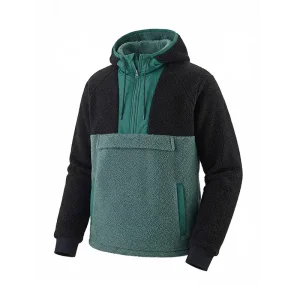
An Executive Overview of Demand Drivers, Regulatory Evolution, and Supply Chain Dynamics in High-Performance Outerwear
The global industrial outdoor workwear market has undergone a structural paradigm shift over the past decade. No longer classified merely as standardized commercial utility wear, modern outdoor work jackets sit at the critical intersection of personal protective equipment (PPE), advanced material science, and ergonomic athletic design. Driven by expanding global infrastructure projects, stringent occupational health and safety regulations (such as OSHA mandates in the United States and EU Directive 89/686/EEC compliance across Europe), and intensifying weather volatility, enterprise demand for highly technical, weather-defying work jackets is experiencing unprecedented growth.
Historically, industrial work jackets relied on heavy canvas, waxed cotton, or bulky synthetic insulations that offered thermal protection at the expense of mobility, breathability, and water resistance. Modern industrial workforces operating in extreme conditions—ranging from offshore wind farm installation crews in the North Sea to sub-zero railway maintenance teams in North America—demand outer garments that execute three simultaneous functions: absolute environmental isolation, dynamic micro-climate heat management, and uncompromised structural durability against mechanical abrasion.
China has firmly established itself as the world's premier manufacturing ecosystem for high-spec outdoor work jackets. Guangdong apparel clusters, specifically facilities like Guangdong Ruiniu Garment Manufacturing Co., Ltd. (operating continuously since 2002), provide an unmatched concentration of technical skill. Sourcing from a premier China outdoor work jacket factory allows global brands and enterprise safety distributors to access integrated supply chains—from localized micro-porous PTFE/PU membrane lamination mills to specialized seam-sealing machinery—delivering superior landed cost margins without compromising strict international technical standards.
Enterprise procurement directors are increasingly moving away from pure "cut-make-trim" (CMT) sub-contractors toward fully integrated OEM/ODM partners in South China. Strategic Chinese manufacturers now provide complete technical advisory: analyzing target market climate thresholds, conducting pre-production lab testing for seam slippage and hydrostatic resistance, and delivering fully certified, retail-ready garments with zero supply chain opacity.
Exploring the multi-layer fabric matrices, membrane chemistries, and construction technologies powering modern workwear.
We engineer multi-tier fabric constructions tailored to specific workload intensities. Our 2-Layer (2L) systems pair a durable hydrophobic face fabric with a suspended mesh liner for daily utility; 2.5-Layer (2.5L) configurations utilize a printed inner coating for ultra-lightpack portability; while our 3-Layer (3L) hardshell systems fuse face fabric, expanded PTFE/ePE membrane, and tricot backing into a single indestructible composite.
Performance in harsh weather depends on balancing water entry pressure with internal moisture dispersion. Our technical work jackets achieve hydrostatic resistance ratings exceeding 15,000mm H2O (ISO 811) alongside Moisture Vapor Transmission Rates (MVTR) above 10,000 g/m²/24h (JIS L1092B). This guarantees total rain exclusion during high-pressure downpours while venting sweat vapor during physical exertion.
A waterproof fabric fails if water penetrates needle punctures. Every stress point in our work jackets is sealed using 13mm to 22mm hot-melt polyurethane or modified rubber seam-taping under precise temperature and pneumatic pressure controls. High-wear zones feature ultrasonic welded seams and laser-cut storm flaps to guarantee 100% dry integrity throughout shift lifecycles.
Cold-climate performance requires variable insulation mapping. We deploy Responsible Down Standard (RDS) certified 600-800 fill power goose/duck down for static extreme cold (-30°C to -40°C), while integrating body-mapped 60g-200g recycled GRS polyester synthetic fill in high-motion areas to prevent insulation clumping, thermal bridging, and moisture trap-back.
Work environments destroy standard textiles. We strategically reinforce elbows, shoulders, lower back, and cuff edges with high-tenacity Cordura® nylon or Kevlar® blended weaves. Tested under ASTM D3884 taber abrasion protocols to 20,000+ cycles, these reinforcement panels shield structural seams from tearing against sharp industrial equipment.
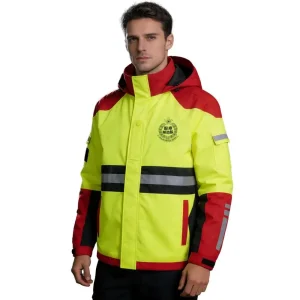
For high-risk environments, optical visibility is critical. Our specialized safety work jackets incorporate EN ISO 20471 Class 3 and ANSI/ISEA 107 compliant fluorescent background materials (fluorescent yellow, orange-red) combined with premium 3M™ Scotchlite™ retroreflective bands engineered to retain reflectivity after 50+ industrial wash cycles.
| Performance Tier | Hydrostatic Rating (ISO 811) | MVTR Breathability (JIS L1092) | Fabric Construction | Ideal Application Scenario |
|---|---|---|---|---|
| Industrial Extreme (3L) | 20,000mm H2O+ | 15,000 g/m²/24h | 3-Layer Bonded Ripstop Nylon + ePTFE Membrane | Offshore Oil & Gas, Arctic Mining, Deep-Sea Ports |
| Commercial Safety (2.5L) | 15,000mm H2O | 10,000 g/m²/24h | 2.5-Layer Polyester + Printed PU Membrane | Highway Construction, Utility Maintenance, Freight Rail |
| Thermal Expedition | 10,000mm H2O | 8,000 g/m²/24h | 2L Oxford + RDS 700FP Down / 150g Synthetic Fill | Cold-Chain Logistics, Sub-Zero Construction, Forestry |
| Dynamic Softshell | 8,000mm H2O | 5,000 g/m²/24h | 3-Layer Bonded 4-Way Stretch + Microfleece Liner | Supervisory Field Engineering, Mobile Logistics, Airport Tarmac |
Tailoring Outerwear Engineering to Specific Regional Climates and Sector Hazards
Operating Challenge: Temperatures dipping to -40°C combined with gale-force arctic winds, heavy snowfall, and continuous mechanical friction against steel structures.
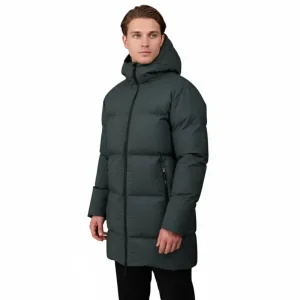
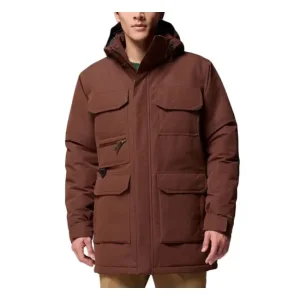
Tailored Solution: Multi-layer insulated parkas featuring heavy-duty 300D Oxford face fabrics treated with PFC-free Durable Water Repellent (DWR). Extended length cut blocks wind infiltration, while dual storm-flap zippers, internal fleece cuffs, and integrated thermal powder skirts retain inner heat pockets. Critical stress seams utilize anti-freeze seam tapes rated down to -45°C without brittle cracking.
Operating Challenge: Constant exposure to salt spray, heavy downpours, chemical lubricants, and high moisture vapor accumulation during heavy physical labor.
Tailored Solution: 3-Layer hardshell jackets built with salt-water resistant hydrophobic membranes and anti-corrosive plastic resin YKK AquaGuard® zippers. Neoprene cuff seals prevent water ingress when arms are raised overhead. High-visibility orange highlights and 3M SOLAS grade marine reflective tapes ensure emergency radar/optical detection.
Operating Challenge: Low-light roadway operations requiring strict EN ISO 20471 Class 3 compliance, frequent dirt exposure, and severe wear at joint bends.
Tailored Solution: Modular 3-in-1 jackets featuring a high-visibility waterproof outer shell paired with a zip-out insulating fleece or padded liner jacket. Fluorescent backgrounds are coated with stain-repellent finishes, and 4-way stretch panels are woven into shoulder blades and underarms to minimize worker fatigue during extended shifts.
Operating Challenge: Rapid transition between freezing cold rooms (-25°C) and ambient warehouse loading bays, leading to rapid sweat condensation inside standard jackets.
Tailored Solution: Breathable, lightweight padded work jackets with zoned insulation. Moisture-wicking 3D mesh back-liners draw sweat vapor away from skin during heavy lifting, preventing dangerous chill when workers re-enter walk-in freezers.
How AI Automation, Sustainable Chemistry, and Smart Textiles are Redefining China's Workwear Manufacturing Base
Global regulatory deadlines (including California's AB 1817 and EU REACH PFAS restrictions) are accelerating the complete phase-out of per- and polyfluoroalkyl substances in water-repellent fabric coatings. As a forward-thinking China outdoor work jacket manufacturer, our R&D lab has successfully integrated bio-based C0 DWR finishes and non-fluorinated plant-derived membranes that deliver equal water repellency (initial spray rating 90+ after 20 washes) without persistent environmental bio-accumulation.
Simultaneously, circular design principles are reshaping garment construction. We are pioneering single-polymer (mono-material) work jackets—where the face fabric, membrane, lining, zipper tape, and sewing threads are all produced from 100% recycled PET polyester (GRS Certified). This enables post-industrial workwear to be shredded and mechanically recycled into raw polyester chips at end-of-life without labor-intensive manual component stripping.
Precision manufacturing defines modern Chinese apparel production. By implementing automated 3D CLO software during the design phase, our engineers simulate garment drape, tension points, and thermal insulation mapping prior to physical fabric cutting. CAD-driven pattern nesting algorithms increase fabric yield utilization past 88%, drastically minimizing high-performance fabric waste and passing landed cost savings to enterprise buyers.
Integration of flexible carbon-nanotube heating panels powered by low-voltage USB power banks, providing micro-controlled thermal regulation across chest and back regions.
Prototype integration of conductive threads and posture-monitoring sensors to alert safety officers when workers exceed dangerous lifting weights or exhibit heat stroke symptoms.
Replacing traditional sewing needles with continuous ultrasonic welding machines to eliminate needle punch-holes entirely, reducing weight and boosting seal life by 35%.
A De-risked, Fully Auditable Manufacturing Process for Global Brands, Wholesalers, and Importers
Sourcing technical garments from overseas involves strict risk management. Guangdong Ruiniu Garment Manufacturing Co., Ltd. eliminates sourcing risk by applying a structured, transparent 6-stage manufacturing protocol backed by 23+ years of technical outerwear heritage.
While traditional factories mandate 2,000+ piece minimums, we support emerging brands and specialized enterprise bids with accessible minimum order quantities starting at 100 pieces per style (splittable across colors and sizes). For established global buyers, our 6 production lines yield over 600,000 technical jackets annually.
Quality assurance is embedded into every assembly stage: 1) Raw Material Gate (4-point inspection system for hydrostatic head, color fastness, and tear strength); 2) In-Line Patrol (hourly checks on seam taping temperature and stitch density); 3) 100% Pre-Shipment Audit (water-column testing of finished garments under AQL 2.5 criteria).
We provide full audit trails required for enterprise compliance: OEKO-TEX® Standard 100 fabric safety, bluesign® chemical management, Responsible Down Standard (RDS) chain-of-custody, GRS recycled materials verification, and ISO 9001 / ISO 14001 factory management accreditation.
Our dedicated sample room—staffed by 12 veteran master patternmakers—turns tech packs or reference samples into physical prototype samples within 7 to 10 working days. English-speaking technical merchandisers provide daily WIP photo reporting and instant DFM (Design for Manufacturability) cost optimization feedback.
Technical Insights & Commercial Procurement Clarifications for B2B Sourcing Managers
Our standard manufacturing MOQ is 100 pieces per style, which can be distributed across multiple colorways and a standard size run (S through 5XL). For high-spec enterprise development programs or pilot testing on stocked technical fabrics, we can also accommodate 50-piece sample runs to help buyers validate market response before committing to large-scale production runs.
Proto sample development typically takes 7 to 10 working days once the tech pack, pattern, and initial fabric lab-dips are approved. Bulk production lead times average 30 to 45 days following Pre-Production (PP) sample sign-off and fabric arrival. Complex 3-Layer seam-sealed garments or custom-dyed high-vis lots sit at the 40-45 day window.
We routinely manufacture garments rated from 8,000mm up to 20,000mm hydrostatic head (ISO 811) and 5,000 to 15,000 g/m²/24h breathability (JIS L1092B). All seam-taped styles undergo hydrostatic pressure spot checks during production, and third-party laboratory test reports from SGS, Intertek, or TÜV can be issued per batch upon request.
Yes. We specialize in Class 2 and Class 3 safety apparel. We source certified fluorescent yellow, orange-red, and navy contrast fabrics alongside certified 3M™ Scotchlite™ or equivalent retroreflective tapes. Our patterns strictly follow minimal reflective surface area metrics to guarantee compliance in European, North American, and Australian markets.
OEM (Original Equipment Manufacturing): You supply the tech pack, CAD patterns, BOM (Bill of Materials), and measurement specs, and we execute precise manufacturing to your exact specs.
ODM (Original Design Manufacturing): You provide a visual design concept, target price point, and performance target; our internal design team develops the patterns, sources compatible fabrics, creates 3D CLO visual renders, and builds a production-ready garment from scratch for your private label.
Seam tape longevity is ensured by calibrating automatic hot-air taping machines for temperature, air speed, and pressure according to the specific membrane backing (PU, TPU, or PTFE). Down leakage is prevented by using high-density down-proof 20D/40D nylon inner linings, deploying anti-static German SCHMETZ round-point needles, and applying down-proof coating treatments to all internal baffle chambers.
FOB pricing is primarily driven by: 1) Fabric and membrane choice (3L PTFE vs 2L PU); 2) Insulation type & weight (RDS Goose Down vs Standard Synthetic Polyfill); 3) Trim specifications (YKK AquaGuard® waterproof zippers vs standard coil zippers); 4) Seam sealing length and complexity; and 5) Total order volume per colorway.
We hold independent export licenses and ship under FOB Shenzhen / Guangzhou, CIF, CFR, or DDP (Delivered Duty Paid) terms directly to your warehouse. Our logistics team handles all customs export documentation, Certificate of Origin (Form E, CO) filings, and packing lists to ensure seamless customs clearance.
Comprehensive product options available for OEM order customization, private labeling, and regional distribution.
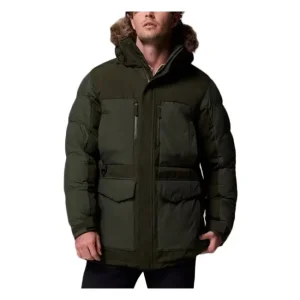
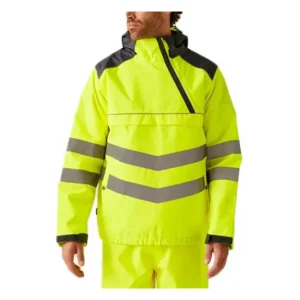
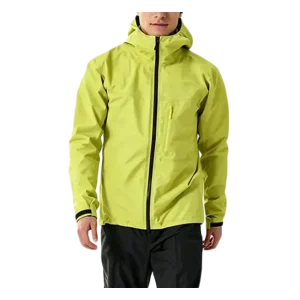
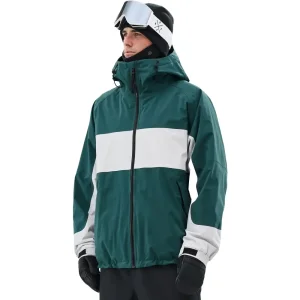
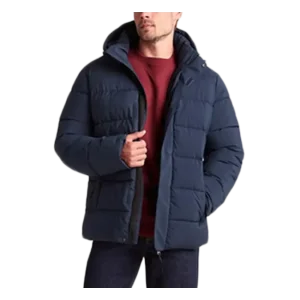
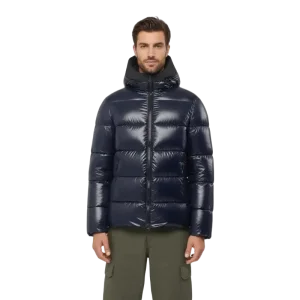
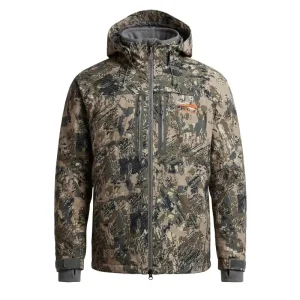
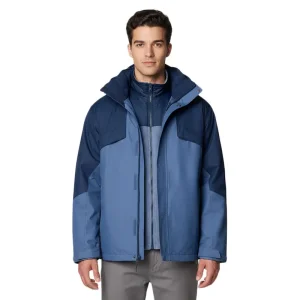
Partner directly with Guangdong's leading technical workwear engineering team. Send us your tech packs, target specs, or reference garments for a rapid DFM evaluation and transparent factory-direct quotation within 24 hours.